Distributed Indexing
Warning
Lance exposes public APIs that can be integrated into an external distributed index build workflow, but Lance itself does not provide a full distributed scheduler or end-to-end orchestration layer.
This page describes the current model, terminology, and execution flow so that callers can integrate these APIs correctly.
Overview
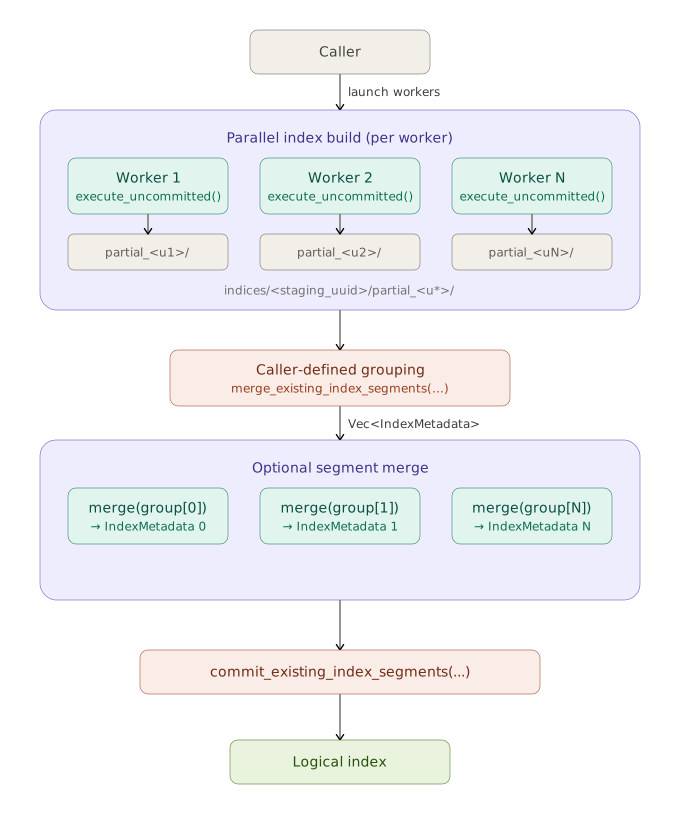
Distributed index build in Lance follows the same high-level pattern as distributed write:
- multiple workers build index data in parallel
- the caller invokes Lance segment build APIs for one distributed build
- Lance plans and builds index artifacts from the worker outputs supplied by the caller
- the built artifacts are committed into the dataset manifest
For vector indices, the worker outputs are segments stored directly
under indices/<segment_uuid>/. Lance can turn these outputs into one or more
physical segments and then commit them as one logical index.
Terminology
This guide uses the following terms consistently:
- Segment: one worker output written by
execute_uncommitted()underindices/<segment_uuid>/ - Physical segment: one index segment that is ready to be committed into the manifest
- Logical index: the user-visible index identified by name; a logical index may contain one or more physical segments
For example, a distributed vector build may create a layout like:
indices/<segment_uuid_0>/
├── index.idx
└── auxiliary.idx

indices/<segment_uuid_1>/
├── index.idx
└── auxiliary.idx

indices/<segment_uuid_2>/
├── index.idx
└── auxiliary.idx
After segment build, Lance produces one or more segment directories:
indices/<physical_segment_uuid_0>/
├── index.idx
└── auxiliary.idx

indices/<physical_segment_uuid_1>/
├── index.idx
└── auxiliary.idx
These physical segments are then committed together as one logical index. In the
common no-merge case, the input segments are already the physical
segments and build_all() returns them unchanged.
Roles
There are two parties involved in distributed indexing:
- Workers build segments
- The caller launches workers, chooses how those segments should be turned into physical segments, provides any additional inputs requested by the segment build APIs, and commits the final result
Lance does not provide a distributed scheduler. The caller is responsible for launching workers and driving the overall workflow.
Current Model
The current model for distributed vector indexing has two layers of parallelism.
Worker Build
First, multiple workers build segments in parallel:
- on each worker, call a shard-build API such as
create_index_builder(...).fragments(...).execute_uncommitted()or Pythoncreate_index_uncommitted(..., fragment_ids=...) - each worker writes one segment under
indices/<segment_uuid>/
Segment Merge
Then the caller decides whether those existing segments should be committed as-is or merged into larger segments:
- keep the worker outputs as-is and commit them directly with
commit_existing_index_segments(...), or - group one or more existing segments and call
merge_existing_index_segments(...)for each caller-defined group - commit the final segment list with
commit_existing_index_segments(...)
Within a single commit, built segments must have disjoint fragment coverage.
Internal Finalize Model
Internally, Lance models distributed vector segment build as:
- build one uncommitted segment per worker
- optionally merge caller-defined groups of existing segments
- commit the resulting segments as one logical index
The merge step is driven directly by the IndexMetadata returned from
execute_uncommitted().
This is intentionally a storage-level model:
- segments are worker outputs that are not yet published
- physical segments are durable artifacts referenced by the manifest
- the logical index identity is attached only at commit time
Segment Grouping
The caller chooses the final segment grouping:
- keep segment boundaries, so each worker output is committed directly
- merge multiple existing segments into a larger segment before commit
The grouping decision is separate from worker build. Workers only build segments; Lance applies the segment build policy when it plans physical segments.
Responsibility Boundaries
The caller is expected to know:
- which distributed build is ready for segment build
- the segment metadata returned by worker builds
- how the resulting physical segments should be published
Lance is responsible for:
- writing segment artifacts
- planning physical segments from the supplied segment set
- merging segment storage into physical segment artifacts
- committing physical segments into the manifest
If a staging root or built segment directory is never committed, it remains an
unreferenced index directory under _indices/. These artifacts are cleaned up
by cleanup_old_versions(...) using the same age-based rules as other
unreferenced index files.
This split keeps distributed scheduling outside the storage engine while still letting Lance own the on-disk index format.